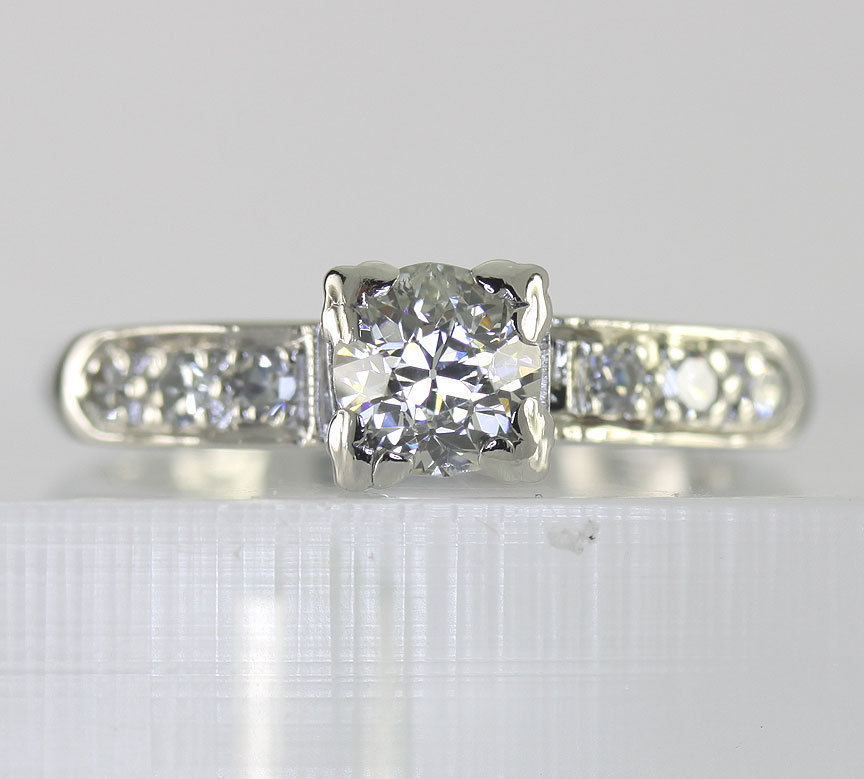
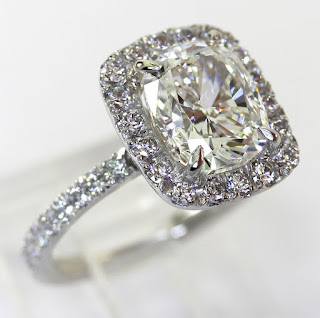
With the new year upon us, we thought it would be a good time to
review some gemstones basics, starting with one of the most beloved of
all gems, the diamond.
Diamond Basics
Diamonds
are crystals made of pure carbon, and are the only gemstone composed of
just one element. Small amounts of other elements might be in diamonds
as impurities, and often give diamond its color variation.
Diamonds
are formed under crushing pressures and intense heat, mostly in the
Earth’s mantle and delivered to the surface by deep-source volcanic
eruptions. These eruptions produce the kimberlite and lamproite pipes
that are sought after by diamond prospectors.
Diamonds have a
hardness of 10 on the Mohs Scale. For millennia, diamonds have been
thought to be the hardest material in nature. But in 2009, a composite
material containing the mineral wurtzite boron nitride (w-BN) was shown
to have the same resistance to indentation as diamond. In fact, research
in China and the U.S. suggests that pure w-BN is significantly harder
than diamond.
About 2,500 years ago, diamonds were first
discovered in India. While the U.S. is the largest consumer of diamonds,
there is barely any production here. The only mine is a state park
called the Crater of Diamonds State Park in Arkansas where tourists can
pay a fee to look for diamonds. The park yields just a few hundred
carats per year.
The Four Cs
In the ‘40s
and ’50s, the Gemological Institute of America (GIA), an educational and
research non-profit organization founded in 1931, developed the “4Cs”
and the GIA International Diamond Grading System™ to objectively compare
and evaluate diamonds. Today, even if you buy or sell a diamond in
another part of the world, the jeweler will likely use the same GIA
grading systems. The 4 Cs are:
- Color: Most
diamonds run from colorless to near-colorless, with slight hints of
yellow or brown. “Color” is not how much color a diamond has, but the
degree to which it is colorless. The GIA set the industry standard with
its D-Z scale (D is colorless while Z means the diamond has the most
yellow.) The exception to this rule are fancy colored diamonds which
aren’t included in the GIA’s D-Z scale. Colors beyond the Z color are
considered fancy colored diamonds.
- Clarity: Most
diamonds have tiny crystals, feathers, or clouds within them, called
“inclusions.” Surface imperfections are called “blemishes.” The rarest
diamonds are flawless and have no internal inclusions or external
blemishes. The GIA uses a Clarity Scale of 11 grades that are measured
using 10X magnifications.
- Carat:
Signifies the weight—not the size—of the diamond. One carat is equal to
200 milligrams. Since heavier diamonds are rarer than smaller diamonds,
the value is higher the heavier the carat weight.
- Cut: The
cut of a diamond refers to its proportions, symmetry, and polish. When
evaluating cut, two aspects are assessed: shape (round, marquise, square
cut, etc.), and how well the cutting was executed. It must be
geometrically precise, since it will affect a diamond’s fire (the flash
of rainbow colors from within) and brilliance (its sparkle). The cut was
historically the most subjective and difficult to standardize during
appraisal, but due to advances in technology, the GIA introduced its cut
grading system in 2005.
Fancy Colored Diamonds
Not
all diamonds fall into the typical white-yellow-brown color range. They
can be pink, blue, purple, red, orange, or any color. Colored diamonds,
known as authentic fancy colored diamonds, get their color from the
trace elements they are exposed to. For example, radiation can create a
greenish tint, while large amounts of nitrogen causes a yellowish color.
Real natural fancy colored diamonds are very rare and expensive, but
through irradiation and heat treating, gemologists are able to enhance
the color of most natural diamonds. Fancy colored diamonds are found in
12 different colors, with more than 90 secondary hues and nine intensity
levels within the 234 color combinations.
Fancy colored diamonds
are graded a bit differently than white diamonds. The four main criteria
for determining a fancy colored diamond’s value are hue, color
saturation, color purity, and availability. The more rare a diamond is
in color, the more valuable it will be. If the color is richer or
saturated, the diamond will also be worth more. And like a white
diamond, a colored diamond’s clarity or purity of the color will also
increase its value. Also, inclusions can be desirable. Inclusions are
actually flaws, but in a colored diamond, they can create unique tones
and beautiful flashes of color.
Synthetic Diamonds
People
have been able to manufacture diamonds since the 1950s. These are known
as synthetic diamonds. Today, more than 100 tons of diamonds are
manufactured every year. Most of these diamonds are used to make cutting
tools and abrasives. Synthetic diamonds are often undistinguishable
from naturally occurring diamonds, but they can be identified by
laboratory tests.
Cleaning Diamonds
For
diamonds not in a metal setting, gently clean the diamond with a
solution of ammonia and water. For diamonds in metal settings, soak the
piece in a solution of warm water and mild detergent for two to five
minutes. Gently scrub the diamond with a soft toothbrush or jewelry
brush. Then, rinse the diamond in warm water to remove remaining
detergent. Buff the diamond dry with your cloth.
Whether you’re
getting engaged or just looking to buy beautiful, quality diamond
jewelry, Adina by Empire Jewelers has a magnificent collection of estate
and vintage diamond jewelry, available at true wholesale prices, as
well as a wide variety of precious and semi-precious gemstone and gold
jewelry.
Shop online today, and remember, if you have any questions, please don’t hesitate to
contact us.